Detailed design
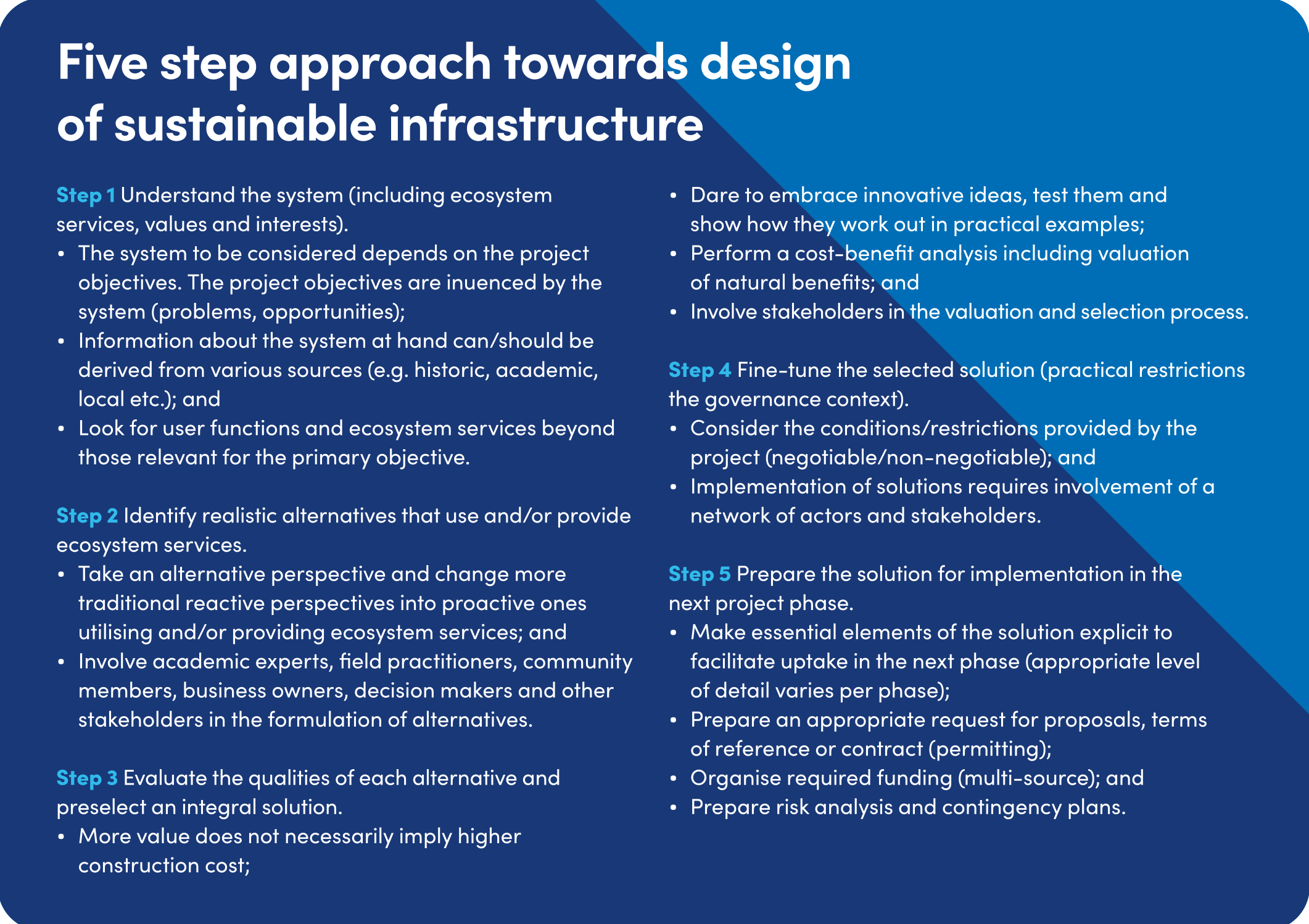
The process described in box 2 and 3 has been called
a process of “objectification”, underlining the need
to specify clear objectives on the one hand, and the isolation of design components that can become objects of
study on the other, both with the aim to rationalise the project
development process. Its application in practice generally involves
the following stages:
- Define the concept's strategic objective and identify crucial
individual design components;
- For each design component specify operational objectives,
boundary conditions and performance indicators;
- Check if design components individually achieve their
operational objective(s);
- Check if design components collectively achieve the strategic
objective as intended in the conceptual design phase; and
- Check how the final solution fits in the local governance context.
Key elements for successful sustainable
infrastructure development
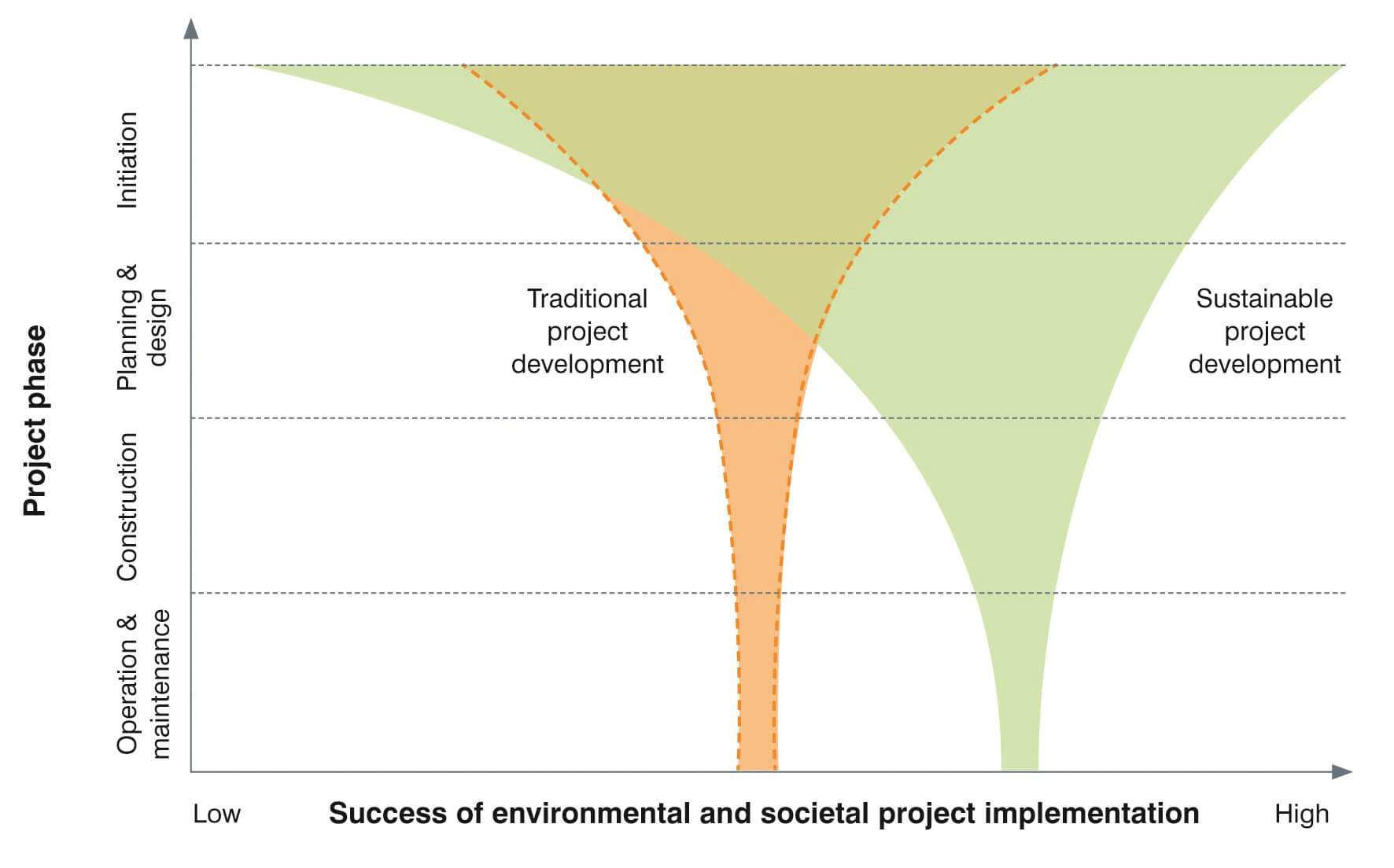
The described conceptual and detailed design steps are
generally undertaken in an iterative manner throughout the
project development process; both diverging and converging
repeatedly. During diverging activities alternative solutions
can be developed and proposed. These are often intuitive
processes where decisions can be guided by professional
judgement. During the converging activities decision-making
should increasingly be guided by an evidence-based approach:
what are the costs, what are the anticipated benefits, how
will the solution achieve its objectives in practice and how
can this be monitored properly? For the primary objectives of water infrastructure developments a proper evidence base is
often available in the form of empirical data and well-tested
models. For the additional objectives that are associated with
sustainability, this is often not yet the case. Uncertainties have
to be dealt with during the proces of designing a sustainable
infrastructure project.
Key elements to facilitate such a design process are:
- multi-disciplinary collaboration;
- stakeholder engagement;
- alignment with legislation, regulations and institutional arrangements;
- good contractual arrangements for design and realisation.
Added value through multi-disciplinary collaboration
The development of sustainable infrastructure solutions
with added value for nature and society involves interplay
of physical, ecological and governance processes. The
combination of these disciplines can yield new opportunities,
which will improve the feasibility of hydraulic infrastructure
projects (engineering perspective), in sensitive environments
(ecologist perspective), while meeting societal wishes and
legislative constraints (governance perspective). Setting up
collaboration between representatives of these disciplines
is already challenging of itself, yet it becomes even more
challenging when you realise that the development and
implementation of new, innovative solutions typically generates
its own resistance.
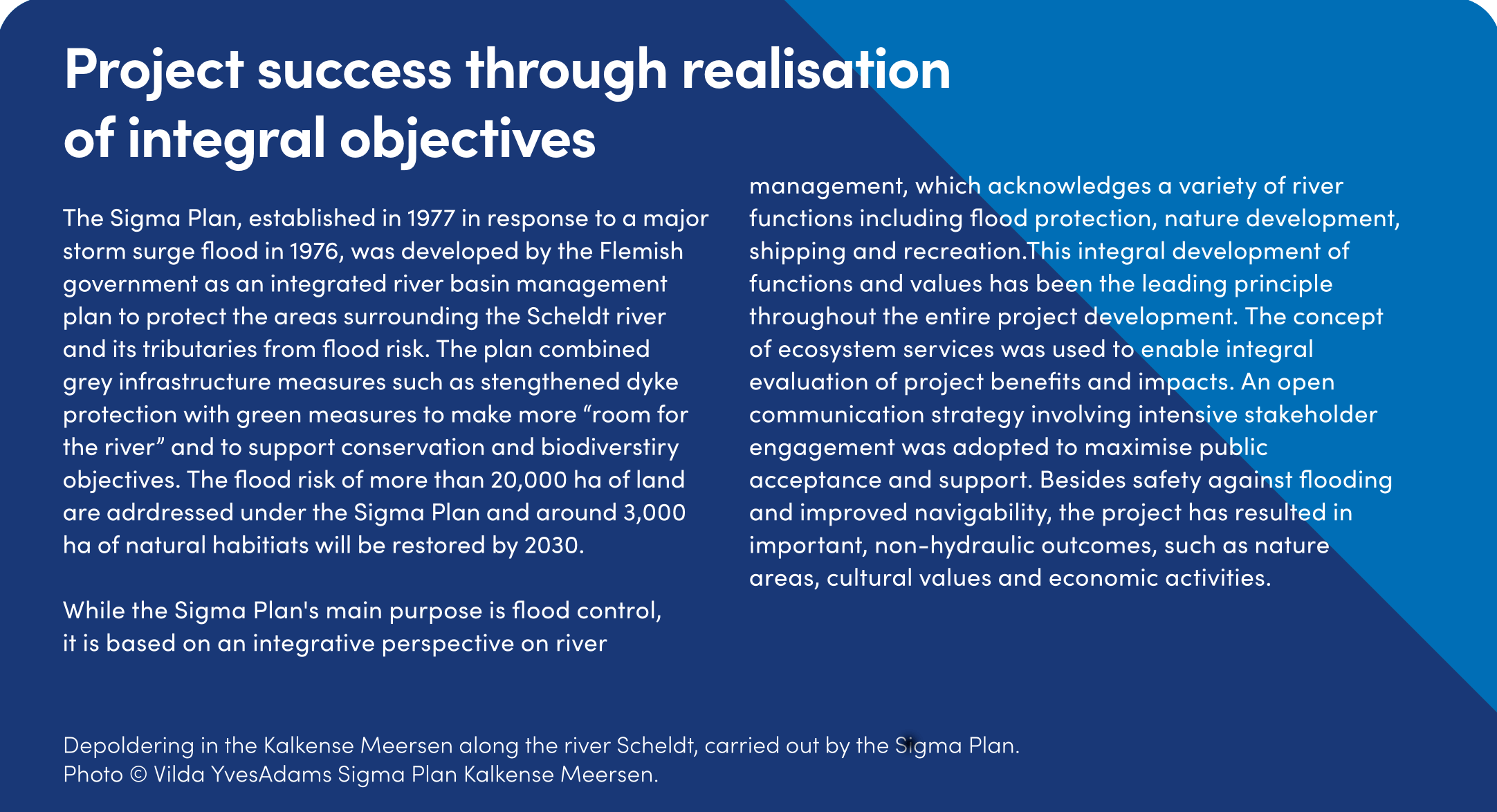
Sustainable infrastructure solutions developed over the last years
(e.g. Sand Engine Delfland the Netherlands, mangrove-protected
shorelines Demak Indonesia, Amazonehaven Rotterdam the
Netherlands, Horseshoe Bend Dredging Atchafalaya River United
States, amongst others) have shown that it usually takes several
years of intense collaboration to achieve the realisation of a
project in practice. The experience gained from these projects
allows for the formulation of generic guidance for setting up
successful, multi-disciplinary collaborations:
1. Integral approach– Set up a project team that covers all
relevant disciplines. The team should at least represent engineers,
ecologists, policy makers and legislators; note that developing
a better solution in itself is not enough, it should also be feasible
within the existing legislative framework and acceptable to
society. Missing out on key disciplines, even if only of secondary
importance at first glance, may initiate risks and uncertainties that
in the longer run can seriously hamper a project.
2. Knowledge level– Make sure all members of the team bring
in sound expertise from their own discipline and are sufficiently
familiar with the project or case study at hand. Integrated
design of innovative solutions relies on the capability of making
scientifically-robust, in-depth assessments of each key discipline.
Requiring a minimum level of expertise for all members strongly
facilitates interaction amongst team members and smooth
decision-making during for instance integral design workshops.
3. Attitude – Besides a thorough understanding of individual
disciplines, true multi-disciplinary collaboration also requires
team members to be open-minded towards other disciplines.
Awareness of the broader scope will help enormously in
identifying and exploring innovative solutions at the interface of
different fields. A similar attitude is also needed for the translation
of third-party requirements into boundary conditions for more
detailed mono-disciplinary studies, and vice versa the translation
of the outcomes of these expert studies into meaningful findings
for the broader project context.
4. Interaction– Multi-disciplinary collaboration inherently implies
interaction between professionals of diverse background. Make
sure sufficient time is allocated to familiarise with the other
team members and become acquainted with different habits
and cultures. Most notably, collaboration between hands-on
professionals with a strong focus on solutions and rapid outcomes
versus consensus-oriented professionals who put high value on a
balanced process resulting in broadly supported solutions deserves
attention. Needless to say the long time needed to arrive at a
balanced compromise solution is perceived to be totally different
by the two groups of professionals. The importance of a careful
process of team building can therefore not be underestimated.
Early involvement of all key actors is a prerequisite for success.
In addition, the design process should be open and transparent in
every project phase, and the integral design workshops should be
populated with the right participants. Once these aspects are in
place, careful process management is needed to guide the project
development process to a successful end.
Stakeholder engagement
Sustainable infrastructure projects operate on the boundaries
of physical, ecological and socio-economic domains. As a
consequence a multitude of interests and backgrounds are
involved in the successful development of such projects. This is
why they are usually complex and of high exposure. Thoughtful
management of these interests – as well as combining them as
much as possible in a specific design – is essential for project
success. Effective incorporation of interests can only be achieved
by careful engagement of stakeholders. Today, more and more
projects are developed in a stakeholder-inclusive way. However,
due to their novel and innovative nature, sustainable solutions can
encounter resistance, as unfamiliarity often triggers a conservative
response. Attentive identification and involvement of stakeholders
can help make dynamic, sustainable solutions feasible.
Stakeholders can be defined as “any group or individual who
can actively affect or be affected by the project development”.
As such, stakeholders can be anything from individuals affected
by a project through to large-scale NGOs whose organisational
goals are related to aspects of the project. A practical approach
for stakeholder analysis is available, which essentially relies
on a systematic identification and classification of relevant
stakeholders, followed by the assessment of their interests
and power.
Step 1: Stakeholder identification
The decision which stakeholders should be involved in a project
development process is a strategic choice. In general, people should be involved if they have information that cannot be gained
otherwise, or if their participation is necessary to assure successful
implementation of the initiative. Normally, stakeholders are
identified through structured brainstorming sessions by the project
initiators, taking into account both existing networks as well as new
actors gained from public hearings. Considering the innovative
nature of sustainable water infrastructure solutions, it is suggested
to be very open-minded about involving interested stakeholders,
including those you may initially not think of. They may turn out
to be the deciding factor for project acceptance and a driver for
project success.
Step 2: Stakeholder assessment
In participation processes, a large number of stakeholders
can be present. Not all of these stakeholders have the same
attitude towards the project, and they are not equally important
either. Therefore, it is important to identify the role of different
stakeholders in the envisaged project development, so that
specifuc management strategies can be utilised for their
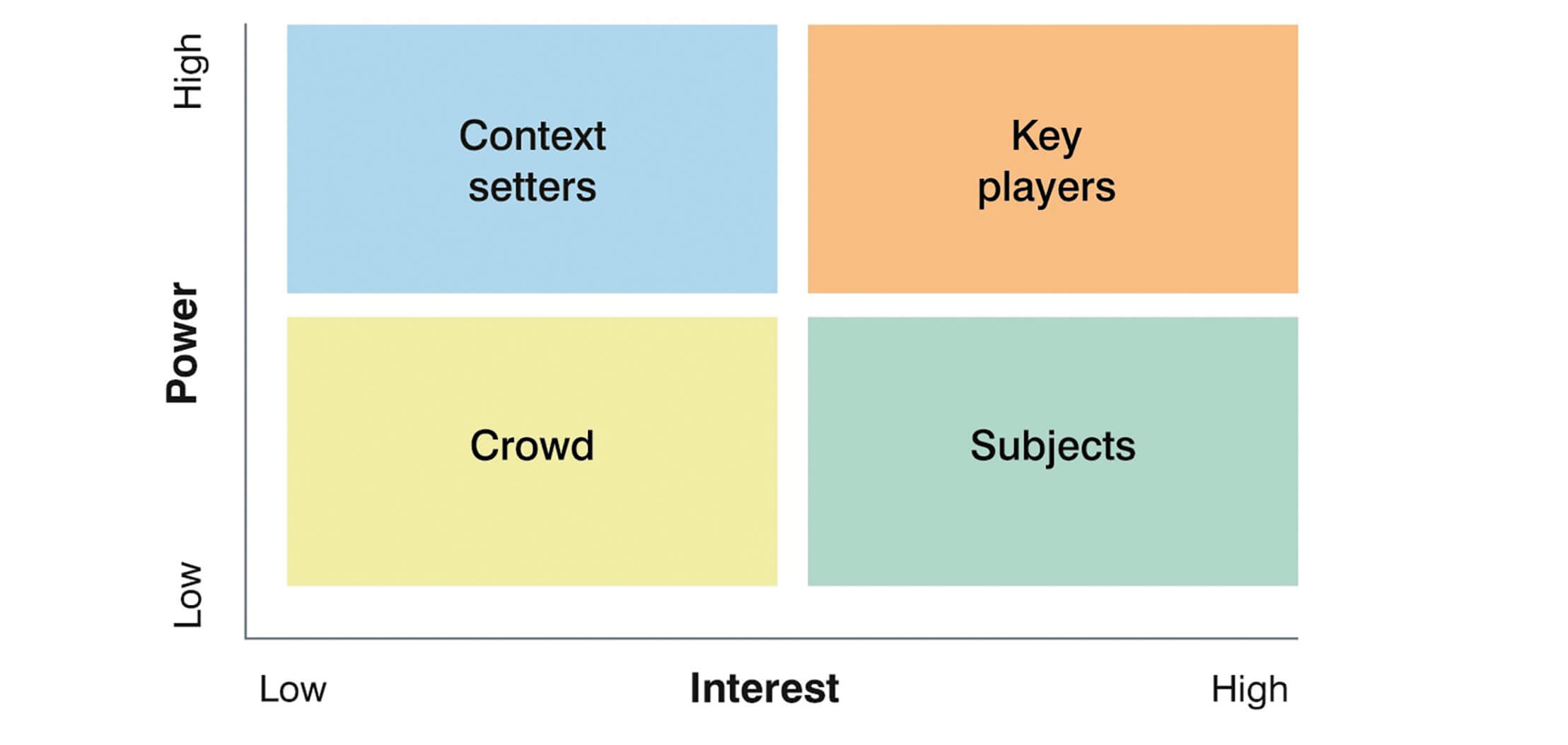
involvement. Stakeholder analysis can easily be done using
stakeholder matrices, such as “power versus interest” or
“problem-frame versus stakeholder”.
By combining interest and power, it is possible to map each
actor in one of four positions in a matrix (i.e. key players, context
setters, subjects and crowd) and prioritise them according to their
importance for the project (see Figure 2).