

Articles in this issue

Editorial: From expertise to execution
Guest editor –
Gerard van Raalte,
Senior Advisor, GRA Consultancy

EQUIPMENT AND METHODS
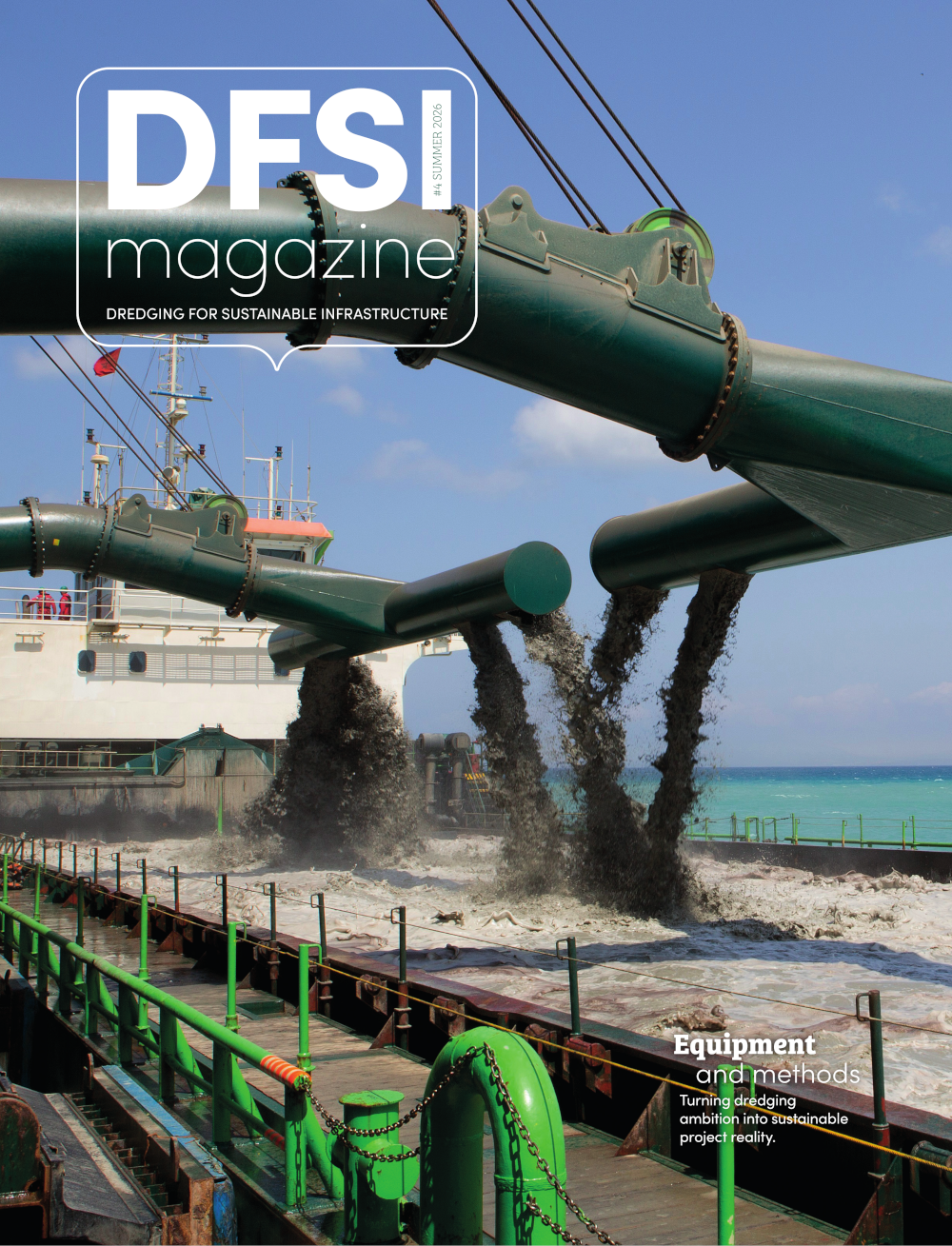
The previous edition of DFSI Magazine focused on assessing and managing sustainability across a project, ensuring impacts are considered during planning, approval requirements are met and the infrastructure performs as intended through construction and operation. It shows that sustainability in dredging is largely determined by operational choices – where equipment, methods and process design translate strategy into real-world impacts. This article, adapted from Chapter 5 of Dredging for Sustainable Infrastructure (2018), focuses on how project objectives can be effectively implemented in practice. It presents the range of dredging tools and methods available, the environmental effects that may arise and how these impacts can be assessed, controlled, managed or mitigated.

Meandering Meuse: integrating sustainable execution into flood protection design
Along the banks of the Meuse River, between the villages of Ravenstein and Lith in the province of Noord-Brabant, the Netherlands, Boskalis will spend the next four years delivering one of the largest integrated dyke upgrades, river widening and area development projects ever undertaken: Meandering Meuse. Sustainability is embedded throughout the project through a connected sequence of decisions spanning both the design and execution phases.

CELEBRATING 40 YEARS OF WATER INJECTION DREDGING
Water Injection Dredging (WID) has been successfully applied in ports and waterways for more than 40 years. Since then, hundreds of projects in dozens of countries all over the world have been executed using this technique. WID is primarily used for maintenance dredging in ports and waterways, particularly in areas where river and tidal currents can transport the dredged sediment naturally. Because WID does not require physical contact with the seabed, it can also be used to clean underwater structures, such as locks and rock revetments, as well as for pre- and post-trenching of cables and pipelines.

TALKING HEADS
As the industry moves towards more adaptive, risk-based approaches, the interplay between environmental requirements and dredging technology will only become more critical. The recent PIANC EnviCom WG 227 guidance challenges the industry to move beyond rigid seasonal restrictions towards risk-based environmental windows. But how far can dredging equipment and methods take us in enabling that shift? We asked two industry professionals how environmental and operational considerations are shaping method selection in practice.

Safer, greener, smarter: Jan De Nul’s uncrewed survey fleet
Survey is the foundation on which every marine and offshore construction project is built. For decades, collecting that data meant putting people in small vessels in all weather, sometimes in genuinely hazardous conditions. At Jan De Nul, that is changing. Over the past four years, the Survey and Environmental Department has made a deliberate shift towards unmanned and robotic platforms and the results speak for themselves across three dimensions: safety, operational efficiency and environmental impact.

DEME’S MEGA CSD Spartacus REDEFINES SUSTAINABLE, MODERN DREDGING
With the increasing focus on sustainability, today’s dredging operations must balance technical feasibility with a firm commitment to environmental responsibility. Meanwhile, intensive urbanisation and growing international trade demand the expansion and deepening of ports and waterways worldwide, and often into hard, rocky seabeds. Taking these global challenges into account, DEME’s Smart Mega Cutter Suction Dredger (SMCSD) Spartacus was designed to redefine the limits of dredging potential, marking a paradigm shift towards sustainable, efficient dredging technology.
PDF download
Download the PDF version of this article with high resolution pictures and layout.
Single-page view

Two-page view
