


Blue carbon – an opportunity for the waterborne transport infrastructure sector
Many ports and harbours operate in and around marine coastal habitats, such as tidal marshes, mangrove forests and seagrasses. Many of these marine coastal habitats are considered blue carbon ecosystems, which play a crucial role in capturing carbon. This article examines how waterborne transport infrastructure impacts blue carbon ecosystems, reviews current mitigation strategies and suggests integrated approaches for sustainable coexistence. We emphasise the importance of collaboration among marine transport authorities, environmental managers, scientists and engineers to protect these essential carbon sinks while supporting the sector's economic contributions.
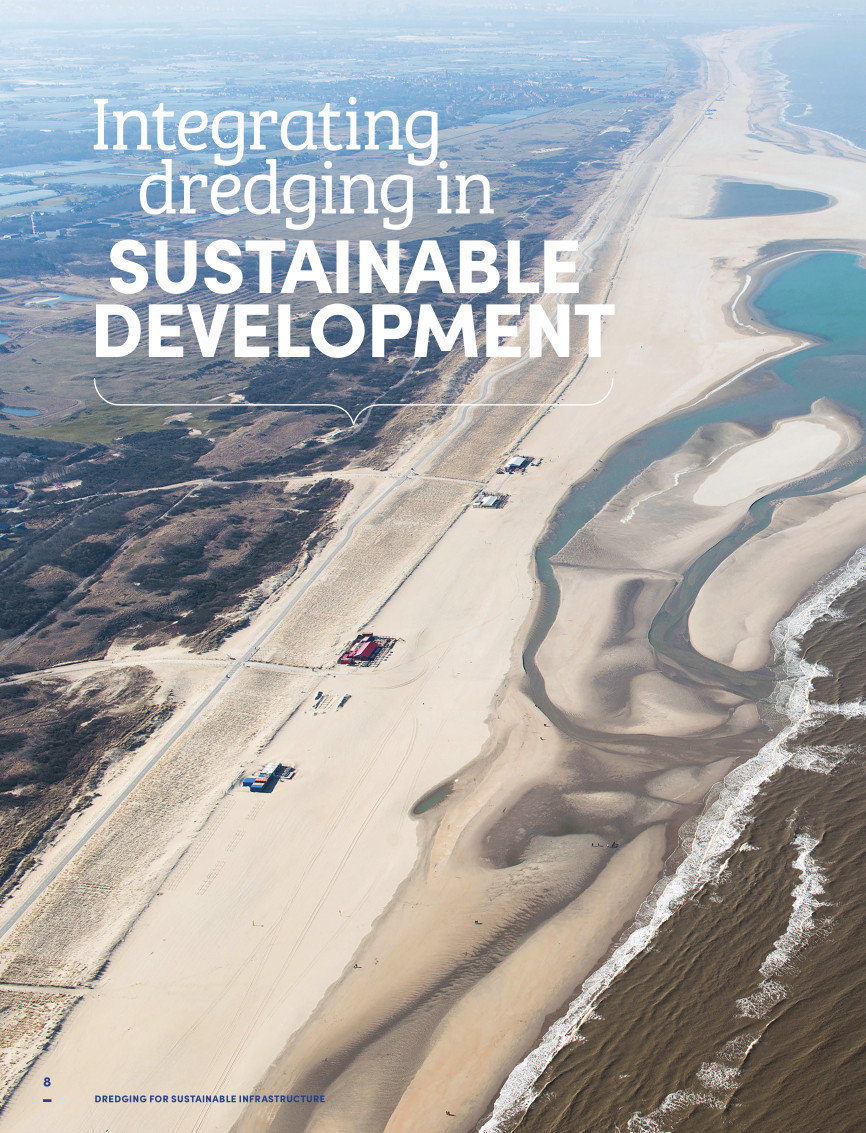
INTEGRATING DREDGING IN SUSTAINABLE DEVELOPMENT
Adapted from the second chapter of Dredging for Sustainable Infrastructure (2018), this article forms the foundation for this first issue and presents the concept of sustainability in relation to dredging projects. It describes the approaches and practices that are key to creating more sustainable solutions and infrastructure – a modern way of thinking about dredging.

Modernisation of the Świnoujście – Szczecin fairway
The idea of a modern maritime access route from the Baltic Sea to the Port of Szczecin in Poland was already born towards the end of 20th century. Quay walls in the neighbouring Port of Police, built in the 80s, were already constructed to accommodate a depth of 12.5 metres and initial modernisation works commenced in the early 90s. On 28 September 2018 the “Modernisation of the Świnoujście – Szczecin Fairway to a depth of 12.5 m” became a reality with the signing of the design and build contract between the Maritime Office Szczecin and the DIVO consortium (Dredging International NV and Van Oord).

Integrating dredging in sustainable development
The International Association of Dredging Companies (IADC) aims to inform the world about the fundamental need for dredging as well as advocating for an industry that makes the world a safer, better and more sustainable place to live. Adapted from the second chapter of the book, Dredging for Sustainable Infrastructure (2018), this article presents the concept of sustainability in relation to dredging projects. It describes the approaches and practices that are key to using dredging and dredge material to create more sustainable solutions and infrastructure – a modern way of thinking about dredging.

Sand as a resource: Best practices to conduct responsible dredging projects

Study of greenhouse gas emissions during ripening of dredged marine sediment
As increasing greenhouse gas (GHG) emissions contribute to global warming, it is becoming more important to consider the carbon footprint of hydraulic engineering projects. This carbon footprint is more complex than previously thought however, as it can also include the carbon dynamics of the sediments from which projects are built. The purpose of this study was to provide a first approximation from sediment-related GHG emissions of dredged sediments. Using the case study of the clay ripening pilot project (‘Kleirijperij’) in Groningen, the Netherlands, one phase of sediment processing was examined: the ripening of dredged sediments for use as a clay material in dyke construction.