

Affirming the importance of safety
Dredging activities can be risky operations with hidden dangers among heavy
machinery. In response, the dredging industry proactively maintains a high level
of safety standards. A representative of contractors in the dredging industry,
IADC encourages its own members, as well as non-members participating in the
global dredging industry, to establish common standards and a high level of conduct
in their worldwide operations.
IADC’s members are committed to safeguarding their employees, continuously
improving to guarantee a safe and healthy work environment and reducing the
number of industry accidents and incidents to zero.
Recognising advancers of safety
IADC conceived its Safety Award to encourage the development of safety skills
on the job and reward individuals and companies demonstrating diligence in safety
awareness in the performance of their profession. The award is a recognition of
the exceptional safety performance demonstrated by a particular project, product,
ship, team or employee(s).
Two safety awards are granted: one to a dredging contractor (also non-IADC
members) and one to a supply chain organisation active in the dredging industry.
This concerns subcontractors and suppliers of goods and services. In total,
14 submissions were received across both categories. Each one aims to improve
routine processes and situations encountered in the dredging industry. The winners
were announced during IADC's Annual General Meeting in Ho Chi Minh City, 14-17
October 2024.
Dredging contractor submissions
PROXIMITY WARNING SYSTEM BY ROYAL BOSKALIS
The Proximity Warning System (PWAS)
serves as a safeguarding measure designed
to protect humans from the dangers posed
by moving machinery, such as bulldozers and
excavators. In the context of the Oxagon
project in Saudi Arabia, there were near
misses of potentially hazardous encounters
between personnel and machinery, which
could have led to dangerous or even
life-threatening situations.
The challenge lies in the operators of
bulldozers and excavators, who may not
always be aware of the presence of a person
nearby, particularly someone approaching
from the sides and in their blind spots.
To mitigate these risks, Boskalis installed
the PWAS system that alerts operators
through voice messages and visual signals
on a monitor. It features adjustable warning
distances tailored to different types of
machinery, enhancing safety protocols.
Employing cameras and AI software capable
of distinguishing a person from inanimate
objects, the system is cost-effective and
easy to implement on standard equipment
as there are no modifications or adaptations
required. The installation process, which
involves four cameras and a monitor, is swift
and only take 2 hours. Since installing the
PWAS system, there have been no recorded
incidents of dangerous interactions between
humans and machinery.

CUTTER HEAD STAIRCASE BY JAN DE NUL
The issue of organising safe repairs on cutter heads has persisted
for a long time. Numerous attempts have been made to improve the
situation, but unfortunately none of the previous initiatives have
been successful. The reasons for these shortcomings have varied,
including large and cumbersome structures, difficulty in installation
or repositioning, in addition to continued exposure to risks related
to lifting and working at height.
Jan De Nul believes its new design has a greater chance of success as it
was developed by the welding team. With their firsthand experience and
deep understanding of the practical challenges, they have crafted a
solution that addresses the main risks more effectively.
The staircase has been designed to improve user comfort and
reduce fatigue. Each step is positioned at an optimal height and angle
allowing technicians to maintain safe and efficient working postures.
This significantly lowers the risk of musculoskeletal injuries compared
to traditional platforms, ensuring that technicians can work longer
without discomfort.
The modular nature of the staircase allows for easy disassembly, transport
and reassembly, and enables quick and efficient set up in various locations,
making it highly adaptable to different sizes and types of cutter heads.

ROV INSPECTION OF QUAY WALLS BY VAN OORD
On infrastructure projects there are a lot of underwater
inspections carried out in building pits and close to
quay walls, which are usually executed by human divers.
This way of working is not without risks and unfortunately,
Van Oord has had fatal accidents in the last years.
To avoid human diver incidents, Van Oord Survey division
deployed diverless inspections by using a remote
operated vehicle (ROV).
Third-party hardware (ROV) in combination with
Van Oord’s in-house developed survey software is a step
forward with respect to safety, efficiency and cost
reduction. The combination of using the ROV with the
survey software turns out to be the winning solution
for quay wall inspections. The software has been used
for many years in Van Oord’s dredging activities and is
well proven.
The combination of viewing sonar and camera images in real
time is a great improvement instead of the hands and eyes
of a human diver. With the presentation of the inspection
results via Van Oord’s GIS viewer, the information can
easily be shared with all the stakeholders. In addition, the
easy to operate equipment makes it very flexible to deploy
on projects.This new way of working with ROVs reduces
the need of human divers by up to 90%. By avoiding human
involvement in underwater inspections, Van Oord has
reduced the chance of (fatal) injuries to zero. In case a
situation arises where a human diver is needed, the work
area will first be secured by an ROV inspection.

ACCESS TO VOID SPACES BY DEME
To enhance safety and efficiency in
accessing and rescuing from confined
spaces with vertical entry, DEME has
developed a new safety device that is
designed to be easily implemented in areas
with limited space and uneven surface. Void
spaces include discharge channels of bow
coupling, jet water lines to the hopper, power
cables to thrusters, general hydraulic lines
and fuel lines. The necessity arose from the
installation of new electrical cables for an
e-excavator, requiring access approximately
every six weeks. The goal is to enhance
safety by providing a stable and secure
method for workers to enter and exit these
hazardous void spaces efficiently.
Current configurations involve using long,
uninterrupted ladders over 8 metres, which
pose safety risks due to limited space as well
as obstructions that hinder safe passage
and setup of tripods. Constructed from
lightweight aluminium for ergonomic
handling, the new design features versatile
mounting with adjustable slot holes to
ensure that the device fits securely over
any manhole of the corresponding size.
The design is exceptionally user-friendly in
every aspect. There are no movable parts or
components to be mounted, except for the
fall arrestor and/or retrieval system.
In addition, improved accessibility is provided
by an integrated handgrip, which aids in
safely entering and exiting a confined space.
The capabilities of a tripod are incorporated
into the device with regards to emergency
rescue. It reduces structural impediments,
guaranteeing safe passage and a clear
evacuation area. Essentially, establishing an
open space environment around the manhole
unlike a traditional tripod.
The minimalistic design is easy to secure,
ensuring it remains stable under any
conditions, yet it can still be easily relocated
when needed. Designed and built in
compliance with EN795 and EN1090
standards, the device can be fitted with a
hinged grating without a locking mechanism.
With this additional element, a ventilator can
be installed on top to provide forced
ventilation. It also ensures that individuals
cannot inadvertently step into an open
manhole. It can also be painted in a high-
visibility colour (black/yellow) to indicate a
confined space working area with its
potential hazards.

PUSH-PIPE SAFETY CLAMP BY ROYAL BOSKALIS
While a TSHD was discharging fine material,
the sandfill team installed a spreader to retain
the material. It was hard to notice that the
material had become coarser, which caused
the spreader to get blocked. This resulted in
increased pressure in the push-pipes causing
the last push-pipe to dislodge and material
being discharged on a nearby excavator. The
excavator sustained damage due to rocks in
the material and could have seriously harmed
personnel in the affected area.
To eliminate the hazard of dislodging push-
pipes near the discharge area, a safety clamp
was installed. Normally, a safety clamp is used
in corners of pipes where the pressure can be
higher due to the bend in the pipe. A piece of
sheet metal (25 mm thick) is sufficient to cut
the safety clamp from. After cutting the metal
into shape, it can be installed directly. A plug
and play solution. It doesn't get easier than
this. It does not require any engineering, high
cost or long production times and has no
negative impact on the environment.
No preparations are therefore necessary,
apart from having a cutting set and sheet
metal available. An easy and low-cost solution,
this device can prevent incidents from
happening on all sandfills throughout the
entire dredging industry. After the push-pipe
safety clamp was installed, no incidents
occurred and the safety of personnel and
equipment was ensured.

AI CAMERA DETECTION SYSTEM BY DEME
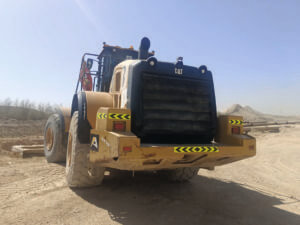
DEME’s improved AI Camera Detection System addresses the implementation of a new and enhanced safety system for earth-moving equipment operators. This new system, which utilises artificial intelligence and advanced cameras, is set to replace the existing radar-based detection system currently used on wheel loaders and dump trucks.

The primary motivation for this upgrade is to address the limitations of the current system. Although it was the best available option at the time of installation, it has several drawbacks, such as a limited detection range of only 7 metres behind the machines, difficulties in detecting persons due to varying light conditions (sun and shade) and an inability to detect objects at the sides or front of the machines. The new AI camera system overcomes these limitations by providing a full 360-degree detection coverage around the equipment, enhancing overall safety.

The main goal of the new system is to
improve personnel safety by preventing
them from coming too close to operational
machines. This is part of a broader traffic
management plan that includes separated
walkways as well as designated maintenance
and parking areas. Key features of the
new system include object detection using
radar at the rear, personnel detection with
AI cameras at the front, sides and rear,
and high-definition screens that display
images from multiple cameras simultaneously.
The system also includes visual and auditory
alarms to alert operators of nearby personnel
or obstacles, and the settings are locked
to prevent operators from making
unauthorised changes.
Test results of the new system have been
positive. It effectively detects individuals,
highlighting them with a red box on the
screen and the audible alarm is loud and
non-adjustable, ensuring that alerts are
always heard. The system provides excellent
visibility in both daylight and darkness,
thanks to its large 10-inch screen and the
power button is deactivated to prevent
accidental shutdowns. Overall, the new
AI camera detection system significantly
enhances the safety of personnel working
around heavy machinery by providing
comprehensive detection and overcoming
the shortcomings of the previous system.

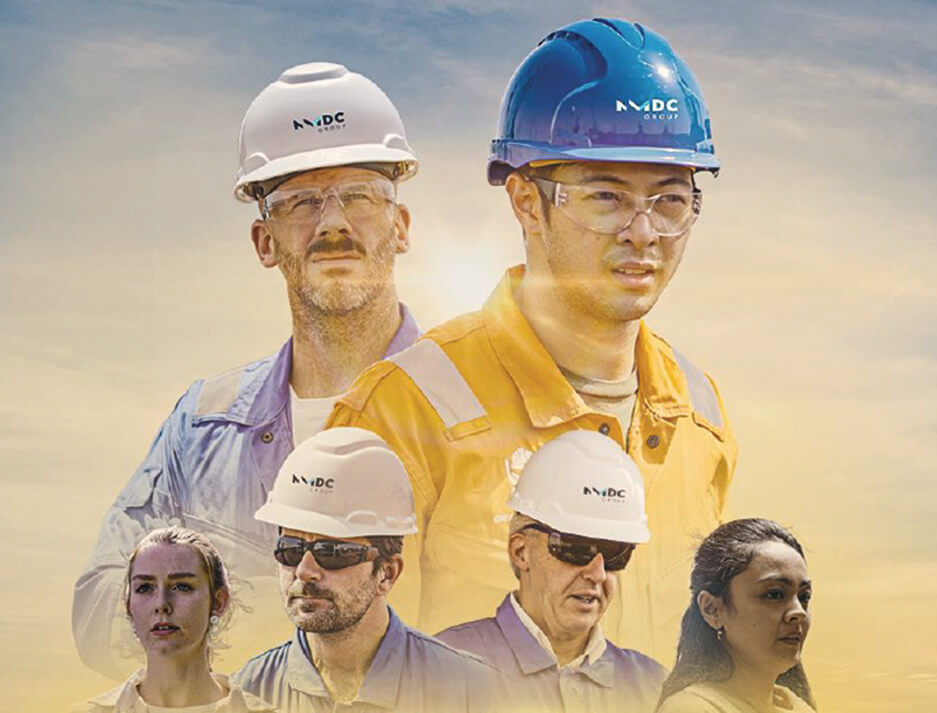
LEADING WITH SAFETY PROGRAMME BY NMDC GROUP
The Leading with Safety programme by NMDC Group
delves into the crucial intersection between leadership
and workplace safety. The company emphasises that
effective safety leadership goes beyond mere compliance
with regulations; it requires a proactive approach that
prioritises the well-being of employees. The programme
outlines strategies for cultivating a safety culture within
organisations, emphasising the role of safety leadership in
shaping attitudes and behaviours towards safety.
Through case studies and practical workshops, the
programme highlights the benefits of integrating safety
into the core values and operations of an organisation. Key
themes include fostering trust, promoting accountability
and empowering employees to take ownership of safety.
NMDC Group's insights underscore the importance of
leadership commitment and consistent reinforcement of
safety principles to achieve sustained improvements in
workplace safety.
By actively involving employees at all levels, the
programme encourages a sense of ownership and
responsibility for safety. This inclusive approach
empowers employees to identify hazards, report near
misses and suggest improvements, creating a feedback
loop that continuously enhances safety protocols.
Furthermore, the programme emphasises ongoing training
and education to ensure that everyone is equipped with
the necessary skills to work safely.
Through consistent reinforcement of safety principles and
celebration of achievements, the Leading with Safety
programme creates a positive safety culture where safety is
not just a priority but a core value. As a result, NMDC Group
experiences reduced incidents, increased productivity and a
safer, healthier work environment for all employees.
CTV SAFETY RAILING BY JAN DE NUL
Jan De Nul has equipped its CTV (DN97)
with an accompanying safety railing, both port
and starboard, which runs along to the front of
the vessel, aiding people during a transfer.
Transfers at sea are a risky activity for many
reasons. The unpredictability of the weather
and the sea can cause accidents to occur,
sometimes with fatal consequences. The
safety railing ensures that a person can go to
the front of the vessel from a safe place on the
deck, guided by a lifeline. Only when the
deckhand agrees to release you can the lifeline
be disconnected from your life jacket.
The innovative railing includes sleek design for
easy (dis)assembly, adaptability to different
sizes, heights and lengths, and a sturdy
construction that can absorb the weight of any
fall. All of which reduces the unsafe feeling of
walking along the side to the front of the vessel.
The safety railing encompasses sliding metal
blocks on a track into which a person clips their
lifeline, which then slides along the rail as they
move. This means the lifeline does not have to
be loosened at any point. Just think of how you
detach and reattach yourself when climbing a
scaffolding. You can move from the back to the
front of the vessel and vice versa in one
smooth and safe movement. Ten people can
use this system one after the other without the
deckhand having to return the track systems.
The safety railing has been designed with
usability and efficiency in mind, making it
easy for crew members and employees to
use. It allows the technical department to
quickly understand how to assemble and
dismantle it, and the simple design minimises
the need for complex instructions or
extensive deckhand training.

DRAG HEAD DESIGN CHANGE BY ROHDE NIELSEN
When backfilling, the grating on the drag
head often gets blocked by rocks. To remove
the rocks requires a lot of manual work and
involves working in an awkward posture.
A process that could easily take an hour or
more and involves working under the drag
head with the risk of getting hit by falling
rocks. Rohde Nielsen therefore set about
changing the design of the drag head with a
movable grating. By simply removing a few
bolts, the side plates and grating can be
eased off, allowing the rocks to freely flow
when backfilling. It eliminates both the issue
causing the hazard and the need for manual
handling, and the dangers of working under
the drag head.
The innovative design is in its simplicity.
By simply changing the design from a
fixed to moveable grating, a solution was
found that greatly improves the safety of
personnel. The new design has been tested
for approximately 6 months with excellent
results. Following the design change, Rohde
Nielsen has suffered no incidents or near
misses and the plan is to start implementing
the change on all its remaining vessels with
a drag head on board.


XBLOCS BY VAN OORD
The diverless placement of concrete armour
units (Xblocs®) utilises advance sensing
technology allowing all data to be stored in an
in-house developed “as laid” 3D real-time block
tracking structure, which includes location and
orientation (roll, pitch, yaw). This data, together
with high quality Echoscope4G® (real-time 3D
imaging sonar developed by Coda Octopus
Group Inc.) mosaics is then sent to the license
holder (DMC) for immediate approval.
Due to constantly optimising the setup and
workflow of placement with respect to
software and hardware, this resulted in the
first “diverless” block placing project.
Thanks to Van Oord’s development, a team
of divers assisting with the submerged
placement of Xblocs® is no longer required,
which in turn eliminates the risks of accidents.
The combination of advanced sensing
technology with real-time tracking, which
results in a 3D model, makes for a fast approval
and an error free administration when utilising
this system. Furthermore, the license holder's
approval (DMC) of the placement by using this
system is already an innovation itself.

Besides the created diverless environment,
the complete process can be visualised and
documented meeting the license holder’s
criteria with respect to production and
placement, which is a must for warranty and
insurance purposes. The common denominator
for Xbloc placement is an in-house developed
tool called TITAN, to create traceability in
installation of objects. Every block has a unique
ID to which additional information is attached
and stored in a large database. A general
labourer equipped with a tablet enters the
Xbloc ID in the TITAN application and when
it is placed by the excavator, the placement
ID is automatically extracted and linked to
the Xbloc ID via a web request.
Since the submerged placement without
divers has been tackled, the safety potential
of the "dry" blocks placement should be
increased to avoid labourers standing or
moving near the excavator's reach. This would
ideally result in block tracking and dynamic
placing for the dry blocks as well, which would
rule out human assistance/involvement as
much as possible.

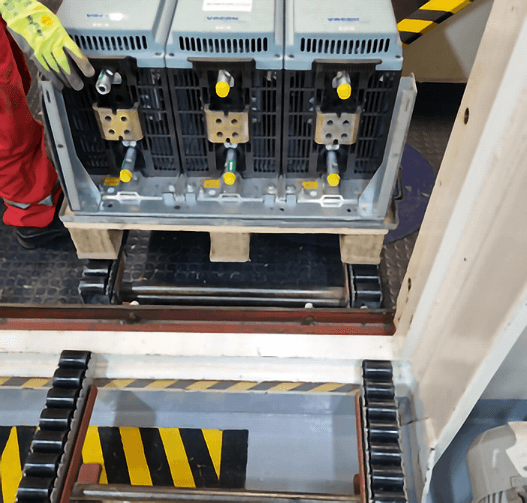
ROLLER TRACKS TO PASS THROUGH WATERTIGHT DOORS BY DEME
In the recent construction of vessels, a common challenge has been the installation of watertight sliding doors with high thresholds, particularly prevalent in older vessels. This obstacle significantly hampers the smooth passage of heavy loads, such as cylinder heads and pallets carrying goods. Historically, various methods were employed to navigate this issue, including the use of chain blocks, pallets with plywood and crane tracks. However, these solutions were not without risks, necessitating careful consideration of safety measures. Recognising the need for a more efficient and safer solution, vessels have introduced roller tracks to facilitate the movement of goods through watertight sliding doors.

This innovative approach has shown promising initial results, offering several advantages over traditional methods. The roller tracks not only enhance efficiency by streamlining the passage of heavy loads but also contribute to improved safety onboard.
Supply chain organisation submissions
ALTUM TELESCOPIC POLE BY CSPECT
The ALTUM telescopic pole system has been developed to easily perform
inspections and actions at height or depth. The system, which is patented,
is an in-house development by Cspect. It consists of different modules
that can be attached on top of an ultra-light telescopic pole of maximum
22 metres. Weighing less than 5 kg, the system is easily transportable and
can be carried as standard luggage/baggage on a plane.
It is a safe, reliable and cost-effective solution to execute general and
detailed inspections. The system avoids the need to use scaffolds,
ladders, rope access, cherry pickers or cranes for visual inspection at
height or depth and thickness gauging of structures at height. With an
easy setup, the ALTUM telescopic pole system can be deployed for
multiple hours without battery stress.
Two modules are currently available. The ALTUM with VISUAL module
for performing close-up inspections allows 360 gimbal of a stabilised
controlled camera with a 62MP output up to 20 metres high or deep.
The ALTUM with the UTM module allows Ultrasonic Thickness
Measurements to be performed with grinding and hammering facility
of steel structures up to 18 metres high.

NON-NUCLEAR DENSITY METER SDM ECO BY RHOSONICS ANALYTICAL BV
The Rhosonics SDM ECO is a cutting-edge, ultrasonic-
based instrument designed to measure slurry density in
real time, offering a safe, non-nuclear alternative for the
dredging industry. It represents a significant upgrade from
the SDM-4 model, featuring enhanced accuracy, faster
response times, a wider operating temperature range and
improved sensor design. This compact, innovative tool
ensures precise monitoring of solids in liquid mixtures,
making it invaluable for applications in dredging, mineral
processing, construction and tunnelling.
Accurate density measurements are crucial for safety
in the dredging industry as they help prevent pipeline
blockages, reduce wear and tear on equipment, and ensure
the stability of dredged materials. By providing real-time
data, the SDM ECO allows operators to make informed
decisions quickly, reducing the risk of accidents and
improving overall operational efficiency. Furthermore,
its non-nuclear technology eliminates the health and
environmental risks associated with traditional
nuclear-based density meters, aligning with modern
sustainability goals.
A true revolution for safety in dredging, the Rhosonics
SDM ECO, unlike traditional nuclear density meters,
eliminates the risk of radiation exposure for workers on
and around dredging equipment. This ensures worker
safety without the need for complex radiation safety
protocols, freeing up valuable time and resources.

Imagine, no more need for licensing, radiation leakage
tests, or the constant presence of a Radiation Safety
Officer (RSO) on-site. The SDM ECO simplifies
operations significantly.
But the safety benefits extend far beyond the removal of
radioactive materials. The SDM ECO provides accurate
real-time data on slurry density, allowing operators to
catch potential problems before they snowball into
serious accidents. This proactive approach helps
prevent pipeline blockages, equipment wear and tear, and
ensures the stability of dredged materials – all of which
can lead to safety hazards on a dredging operation.
The beauty of the instrument lies in its remarkable
ease of implementation. Unlike traditional nuclear
gauges that require a whole list of prerequisites, the
SDM ECO boasts a plug-and-play approach that
minimises pre-installation hassles. Plus, there’s no
need for approvals, permits or dedicated storage for
radioactive materials.
The installation is also easy and intuitive. Its diverse
fittings allow for a quick and straightforward setup. In
most cases you just slide the sensor into the fitting and
secure the mounting flange. Done! Additionally, the SDM
ECO streamlines the calibration process without
sacrificing accuracy, allowing you to get up and running
quickly without wasting valuable time and resources.

ROV BY CSPECT
Cspect is an engineering company based in the Port of Ostend
using remote inspection techniques to inspect assets, therefore
eliminating the use of divers for inspections below water.
Mini and micro ROVs (Remotely Operated Vehicle), which are
portable and versatile are used to perform underwater inspections.
Due to its low weight and small size, the demob and mob costs are
very low. Additionally, all Cspect’s ROVs are electrically driven
without any oil on board. If green power is available, it makes it almost
carbon neutral in its use and without any risk to the environment. In
addition, a various number of sensors can be added onto the ROVs.
Every year, two to four fatalities occur per 10,000 divers. Some of
these events were associated with divers becoming entangled in
nets or divers becoming trapped underwater when they were near
inflow pipes, or openings with lower pressures and were unable to
free themselves from the suction pressure.
Weighing less than 25 kg, Cspect’s ROVs can be easily transported
and require a team of only two engineers to operate the system.
In addition, their ROVs have been optimised to sustain quite some
currents. A diver can work up to 0.5 knots and is limited in working
time below water whereas Cspect micro ROVs can easily work up to
2 knots with almost no limits in working time below water.
In addition to visual inspections by means of high-end cameras,
the ROVs can perform other tasks, such as dimension checks,
thickness measurements, sonar inspections, local cleaning and
PH measurements. So much more than visual inspections only!

PDF download
Download the PDF version of this article with high resolution pictures and layout.
Single-page view

Two-page view
