Environmental Impact Assessment (EIA) and added value
Chapter 4 of the Dredging for Sustainable Infrastructure (DFSI) book discusses the assessment and management activities that need to be implemented to ensure that:
- During the planning stages the project has truly considered its overall sustainability profile (both negative and positive effects) and is able to comply with the necessary approval procedures, and
- During the construction and operation stages the infrastructure design performs as intended (again both with respect to negative and positive effects).
As for any infrastructure project, a design that proactively incorporates added values should also go through a rigorous assessment procedure to see if the project can continue after careful deliberation of positive and negative effects.
Careful appraisal of the potential effect of proposals through EIA should ensure that potential environmental issues and opportunities for added value for the environment are anticipated at an early stage of a water infrastructure project. This allows corrective measures to be incorporated to minimise negative effects or prevent them from occurring, while beneficial effects can be developed within the scope of the project.
In practice, however, most designs are optimised primarily for their economic and technical objectives with the EIA process subsequently applying mitigation measures to reduce any significant negative effects identified. The proactive inclusion of environmental considerations, including added values (natural as well as socio-economic), into the designs from the very start, while in principle facilitated, is not as common as it should be. While the “Environmental Impact Assessment” stage addresses both negative and positive effects, the “Environmental Mitigation and Monitoring” stage tends to focus primarily (if not only) on reducing the negatives. Insufficient mitigation of negatives can jeopardise consent by the regulator. Insufficient stimulation of positives rarely does.
The apparently unavoidable focus on mitigating the negatives ultimately influences the whole EIA process. Consultants performing the impact assessment tend to focus more on identifying and describing the negative impacts as these are the main focus of some of the stakeholders. Stakeholders are conditioned to frame their concerns as negative impact in order to get their interests on the agenda. The resulting implicit focus on mitigating the negatives has a large influence on the design process and the ultimate result, to the extent that it can favour the “least bad yet acceptable” decision over the “more integrated sustainable” one potentially with added value(s).
Basics of the present EIA framework
EIA should strive for a balanced evaluation of effects that are associated with water infrastructure projects; negative as well as positive effects, short-term process effects as well as long-term project effects. A next step is to assess the balance between these effects and decide if it is acceptable “as is”, or whether something needs to be done about it. Most jurisdictions around the world require some form of EIA of water infrastructure projects before consent can be granted. Designs that add value to the (natural and socio-economic) system are no exception.
A World Bank study summary of EIA was important because it more or less established the minimum requirements (Bray, 2008):
“[...] EIA is taken to mean the systematic examination of the likely environmental consequences of proposed projects. The results of the assessment – which are assembled in a document known as an Environmental Assessment (EA) – are intended to provide decision-makers with a balanced assessment of the environmental implications of the proposed action and the alternative examined. The EA is then used by decision-makers as a contribution to the information base upon which a decision is made. The overall goal of an EIA is to achieve better developmental interventions through protecting the environment (human, physical and biotic).”
EIA is an important tool for project planning. It assists in the reduction of risk from misunderstandings, provides clarity on potential environmental implications and leads to better co- operation between all stakeholders, including project owners, dredging contractors and the public. A well-executed and thorough EIA can lead to cost-effective mitigation and/or enhancement. When environmental mitigation/enhancement is integrated as a fundamental part of project design, rather than as an add-on exercise, it can reduce project and community costs.
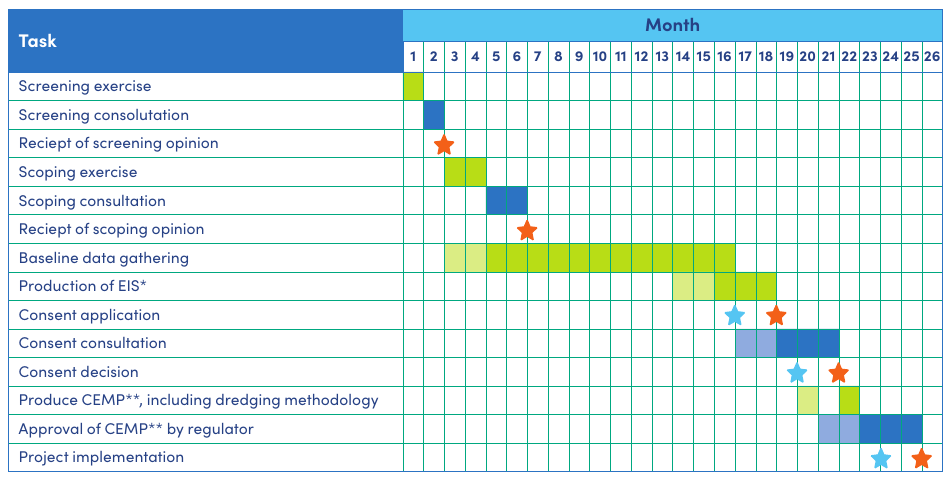
The DFSI book gives an overview and short description of the different stages of an EIA process. Some of these stages will be described below.
Baseline data gathering
The description of the baseline for a study area’s environmental and social conditions (i.e. the area that has the potential to be affected directly and indirectly by the proposed project) is crucial for the assessment and management aspects of any scheme. The baseline provides the reference against which potential changes can be put in context with natural conditions and assessed for the predicted level of significance of any impact. It is also the information upon which the sustainability of the project can be measured. A sustainable project as a minimum will need to prevent long-term degradation of resources as a result of the activity. An understanding of the baseline characteristics, and their natural variability, will enable this to be measured and managed throughout the project life cycle. It is important to realise that each location is different and will require unique consideration of the background conditions, threshold values and likely changes.
Baseline data is generally collated for a number of parameters including, but not limited to, the following:
- Designated site information.
- Important physical processes.
- Water and sediment quality.
- Ecology.
- Fish resources.
- Mammals.
- Ornithology.
- Users of the environment (including fisheries, services, navigation).
- Local community
- Tourism and recreation.
- Archaeology and historic environment.
- Protection and flood defence.
It is important to realise that the work carried out in a baseline survey is supposed to provide the (preferably quantitative) foundation based on which later management measures may be engineered. When designing a baseline monitoring campaign, one should keep this in mind continuously and reflect on whether the campaign is going to deliver the required information. Obviously, the level of survey should be in context with the scale and location of the project and should be designed to meet realistic objectives. Objectives should be specific and have a measurable outcome to determine whether or not they have been achieved. Methods to approach this issue systematically are addressed later in this article.
Mitigation
Management measures to mitigate against project risks and/or stimulate project opportunities can be built into a project at any stage. However, it is often beneficial to consider such measures at an early stage, e.g. during the initial feasibility of the project or early design phase. At this early stage, environmental constraints can be identified and taken into consideration to enable an optimal location for the dredge or method for the dredging, transportation and placement of material.
Appropriate management measures can be selected by following a set process to determine the vulnerability and sensitivity of the receptor and the objective of the project (in terms of project outcome and constraints) followed by consideration of several management measures that may be applied to reduce the significance of an impact. PIANC Report Number 100 (PIANC, 2009b) provides details for a procedure to be followed and provides a selection of management measures for different dredging-related activities.
The selection of the most appropriate management measures should involve expert knowledge from a dredging contractor and should be based on the effectiveness of the measure to achieve the desired goals for environment protection and the amount of effort required to implement the measure. The management measure must be effective in ensuring that the dredging activity does not result in the non-compliance of an environmental objective, but the effort involved in applying the measure should be proportionate to the scale of the project or the impacts. It may be that two smaller management measures in combination would achieve the desired outcome with less effort than one more restrictive measure.
Consider cumulative impact(s)
Once the residual impacts have been assessed for the project it is necessary to determine whether there are any likely cumulative impacts that could occur with other proposed projects planned in the area. In line with Institute of Environmental Management and Assessment (IEMA) guidelines for EIA, cumulative impacts are defined as “... the impacts on the environment which result from incremental impacts of the action when added to other past, present and reasonably foreseeable future actions ...”(EU, 1999).
The requirement for Cumulative Impact Analysis (CIA) initiates from the need to consider the impact of a number of individual projects acting on the same resource. Whilst the individual projects in isolation may not have a significant impact on a resource, the combination of changes brought about by all the projects together may have a significant effect.
The identification of relevant projects and their potential cumulative impacts can be initiated during the scoping stage but will be presented within the Environmental Statement (ES).
A tiered approach can be adopted for a projects CIA, based upon the following definitions:
- Site-specific (or within-project) cumulative impacts – Different aspects of the project’s proposals may have additive or interactive impacts on common receptors. For example, the combined effects of noise, traffic and dust on human receptors and/or ecology; and
- Wider cumulative impacts– These are the combined impacts (additive or interactive) that may occur between any component(s) of the project and any other development(s); that is, other “present” and “reasonably foreseeable” plans and projects.
With respect to “past” projects, a useful ground rule in CIA is that the environmental impacts of schemes that have been completed can be a part of the baseline environment; as such, these impacts will be taken into account in the EIA process and, generally, can be excluded from the scope of the CIA. However, the environmental impacts of recently completed projects may not be fully manifested and, therefore, the potential impacts of such projects should be considered in the CIA.